
![Parkinson's Law: Why Work Expands (And 7 Ways to Beat It) [2026]](https://storage.ghost.io/c/19/68/19684f3e-ff16-4897-81d6-e99793708f7f/content/images/size/w960/2026/02/splash-v8-cozy-desk.png)
I write about engineering leadership, productivity, and building high-performing teams. Subscribe for actionable frameworks.
TL;DR: Parkinson's Law states that work expands to fill the time you give it. Give yourself a week, it takes a week. Give yourself two hours, you'll finish in two hours. Below: the science behind why this happens, real-world examples from software engineering, and 7 battle-tested strategies to beat it.
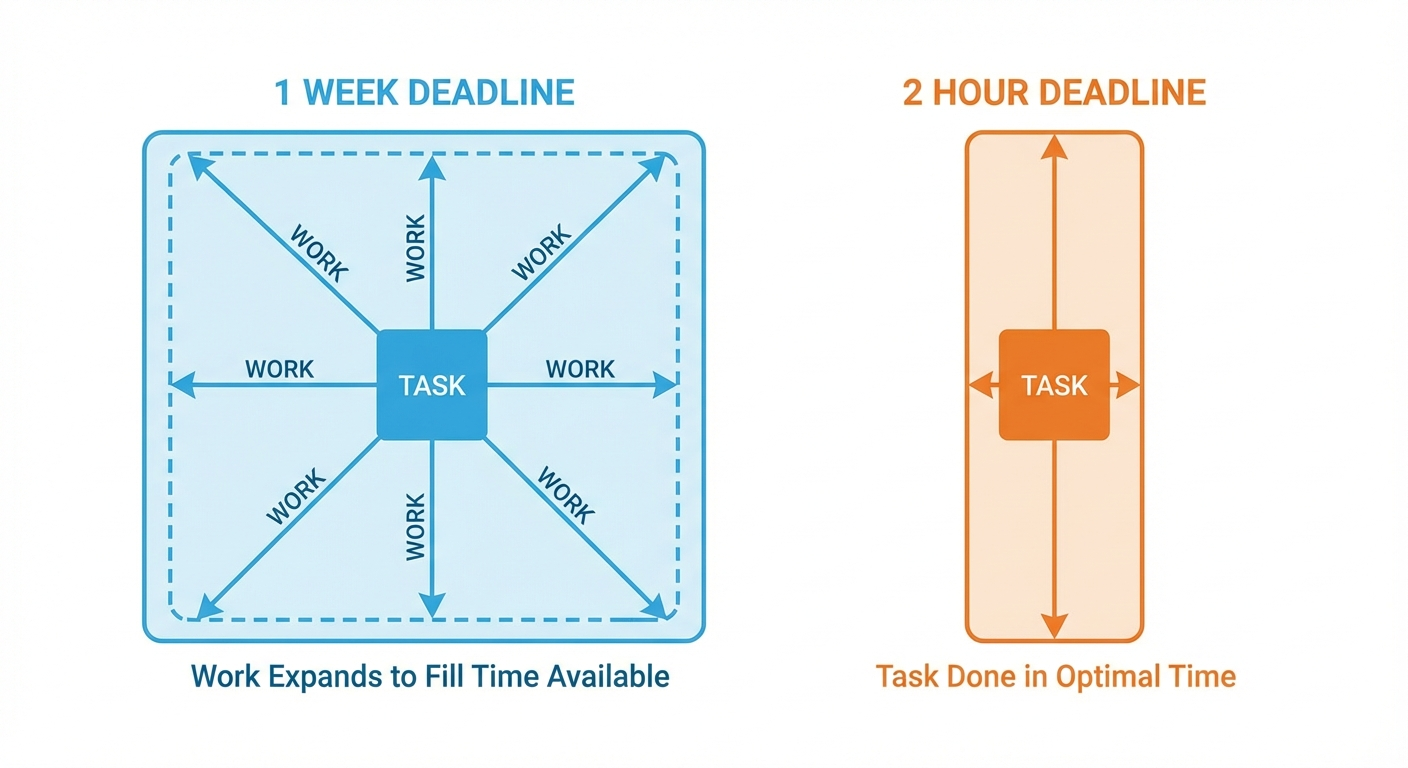
"Work expands so as to fill the time available for its completion."
That line, written by Cyril Northcote Parkinson in a satirical 1955 essay for The Economist, has become one of the most quoted principles in productivity. And for good reason—it's painfully accurate.
I'm using it right now as I write this post. I gave myself a tight deadline, and I'm watching words hit the page faster than they would if I had "all day."
If you've ever wondered why you always seem to finish projects right at the deadline—no matter how much time you had—Parkinson's Law is why. Let's break down the science, look at some spectacular real-world failures, and most importantly: figure out how to make this law work for you instead of against you.
What Is Parkinson's Law?
The core idea is simple: the more time you allocate to a task, the longer it will take.
But there's a sneaky second part most people miss: the task will also increase in complexity.
Here's what that looks like in practice:
Say you give yourself a full day to study a subject. Instead of just studying, you'll start coming up with ways to make it "better":
- "I should reorganize my desk first—can't focus in this mess."
- "Let me research the optimal monitor height for ergonomics."
- "I read that walking improves blood flow and focus. I should take a walk first."
- "Actually, I need coffee. And maybe a snack."
A two-hour task just became an all-day project. And the actual studying? That happens in the final hour, when panic sets in and you realize the day is almost over.
We're all perfectionists at heart. Add in some procrastination, and work will always expand to fill whatever time you give it.
The Science: Why Does This Happen?
Parkinson's observation isn't just folk wisdom—there's real psychology behind it.
The Yerkes-Dodson Law
Back in 1908, psychologists Robert Yerkes and John Dodson discovered that performance increases with pressure—but only up to a point. Too little pressure and you're bored, unfocused. Too much and you're stressed, making mistakes.
The sweet spot is somewhere in the middle: enough pressure to stay sharp, not so much that you crack.
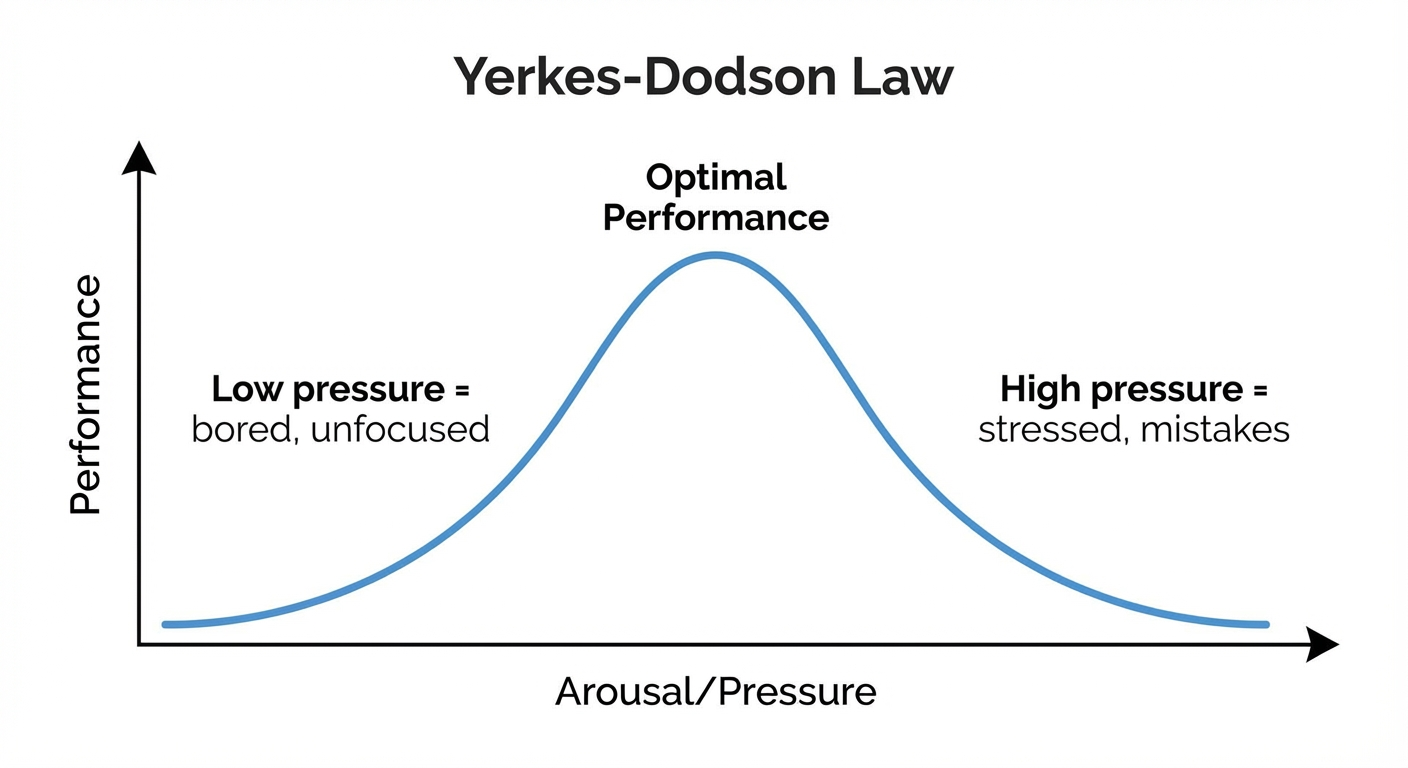
This is why deadlines work. They create the optimal level of pressure to keep you focused and moving. Without them, you drift into the low-arousal zone where every distraction wins.
Student Syndrome
Project managers have a term for this: Student Syndrome. It's the tendency to delay work until right before a deadline, regardless of how much time was available.
Studies on project management (including research published in the International Journal of Project Management) consistently show that tasks started early rarely finish early. Instead, the extra time gets filled with scope creep, perfectionism, or simple procrastination.
Sound familiar? It's why your team's Jira tickets all move on the last day of the sprint.
Hofstadter's Law (The Cousin)
Related to Parkinson's Law is Hofstadter's Law:
"It always takes longer than you expect, even when you take into account Hofstadter's Law."
The two laws together explain why software estimates are famously terrible. We underestimate tasks, then the work expands to fill (and exceed) whatever time we thought we needed.
Famous Examples of Parkinson's Law
The Sydney Opera House

The Sydney Opera House was supposed to take 4 years to build and cost $7 million AUD.
It took 14 years and cost $102 million.
What happened? The timeline kept expanding, and with it, the scope. New design elements were added. The roof design alone went through countless iterations because there was (perceived) time to "get it perfect."
Apple's HomePod Delay

Apple announced the HomePod in June 2017 with a December ship date. It didn't ship until February 2018.
Why? According to reports, Apple kept finding small things to improve. The extra time allowed for expanded scope—tweaks that probably wouldn't have happened under a tighter deadline.
Every Semester You've Ever Had
Be honest: how many times have you had an entire semester to write a paper, only to start it 48 hours before it was due?
The work expanded to fill 15 weeks of "thinking about it" and "planning to start" before compressing into 2 days of actual writing.
Parkinson's Law in Software Development
As an engineering manager, I see Parkinson's Law play out in sprints constantly. Here's what it looks like:
The Two-Week Sprint Problem
You have a two-week sprint. Tickets are estimated, assigned, committed. What actually happens?
- Week 1: Tickets stay in "In Progress." Engineers are "working on it."
- Day 8-9: Some movement. A few PRs go up.
- Day 10 (Friday before sprint end): Suddenly everything is "almost done."
- Final day: Chaos. Emergency PR reviews. Last-minute merges. Half the tickets slip anyway.
The work expanded to fill two weeks, even though the actual coding often took 2-3 days.
Why Estimates Are Always Wrong
Ever notice that a ticket estimated at 3 days takes... 3 days? And a ticket estimated at 1 week takes... 1 week?
That's not because your estimates are perfect. It's because the work expands to match the estimate. A 3-day ticket that could've been done in 1 day gets gold-plated, over-engineered, or simply worked on at a leisurely pace until day 3.
The "Quick Fix" That Took a Sprint
You've seen this one: a bug that "should take an hour" gets assigned to a sprint with buffer time. A week later, the engineer has refactored three services, updated the test suite, and written documentation.
The hour-long fix became a week-long improvement project because the time was available.
7 Strategies to Beat Parkinson's Law
Here's what actually works:
1. Cut Your Deadlines in Half
This is the most direct application. Whatever deadline you'd normally set, cut it in half.
Think you need a week? Give yourself 3 days. Think you need a day? Give yourself 4 hours.
You'll be surprised how often you hit the shorter deadline. And when you don't? You've lost nothing—you can always extend.
2. Timeboxing (The Pomodoro Technique)
Instead of working "until it's done," work in fixed time blocks:
- 25 minutes of focused work
- 5-minute break
- Repeat
The artificial constraint forces focus. You can't let work expand when the timer is ticking.
Tools: Pomofocus, Flow, or just your phone timer.
3. Set "Ship It" Deadlines, Not "Finish It" Deadlines
There's a difference between "finish the feature" and "ship the feature."
"Finish" invites perfectionism. "Ship" demands you get something working out the door.
Reframe your deadlines: "This ships Friday at 5pm, ready or not." Watch how quickly "nice to have" features get cut.
4. Work in Public
Accountability accelerates everything. When you tell someone "I'll have this to you by Thursday," Parkinson's Law meets social pressure—and social pressure usually wins.
Try:
- Daily standups with specific commitments
- Public build logs (Twitter/X, Discord, etc.)
- Accountability partners
5. Batch Similar Tasks
Context switching is the enemy of tight deadlines. If you have 10 small tasks, don't spread them across the week. Block 2 hours and knock them all out.
The constrained time forces efficiency. Spreading them out invites each task to expand independently.
6. Define "Done" Before You Start
Scope creep happens when "done" is fuzzy. Before starting any task, define:
- What does "done" look like?
- What's explicitly out of scope?
- What's the minimum viable version?
Write it down. When you're tempted to add features mid-task, you have something to point to.
7. Use Artificial Constraints
Sometimes the deadline isn't enough. Add other constraints:
- Word limits: "This doc is max 500 words"
- Feature limits: "MVP has exactly 3 features"
- Tool limits: "Build this with no external libraries"
Constraints breed creativity and prevent expansion.
How to Apply This to Your Team
If you're a manager, here are ways to leverage Parkinson's Law at the team level:
Shorter Sprints
Two-week sprints have 13 days of coasting built in. Consider:
- 1-week half sprint tickets complete for faster feedback
- Kanban with WIP limits instead of time-based sprints
- "Minimum viable sprint" commitments
Tighter Story Points
If your team's velocity allows for buffer, you have too much buffer. Commit to slightly more than feels comfortable. The pressure improves focus.
(But don't burn people out—there's a balance.)
Demo-Driven Development
Nothing focuses a team like knowing they have to demo on Friday. The demo deadline is more visceral than "sprint end."
Kill "Stretch Goals"
Stretch goals sound nice but often become primary goals that expand to fill the sprint. Commit to less, ship it, then decide what's next.
FAQ
Does Parkinson's Law apply to creative work?
Yes, but differently. Creative work benefits from some expansion time (incubation). But even creative projects expand infinitely without constraints. Set a "first draft" deadline, not a "perfect draft" deadline.
What if I set a tight deadline and fail?
Then you've learned something about the actual scope of the task. Failing at a 2-day deadline and finishing in 3 days is better than giving yourself a week and taking... a week.
Isn't this just stressing yourself out?
There's a difference between productive pressure and destructive stress. Tight-but-achievable deadlines create focus. Impossible deadlines create burnout. The goal is the sweet spot on the Yerkes-Dodson curve.
How do I convince my team/boss to try shorter deadlines?
Run an experiment. Pick one low-risk task and cut the timeline in half. Show the results. Data beats theory.
Take Action Now
Improving your productivity is rewarding. Every task you ship faster gives you a dopamine hit that reinforces the habit.
Start now:
- Pick one task on your list
- Cut the deadline in half
- Set a timer and start
The work will resist compression at first. Push through. You'll be amazed at what you can ship when you stop giving tasks room to expand.
What's your experience with Parkinson's Law? Have strategies that work for you? Let me know on Twitter/X.
If you found this useful, subscribe for more practical engineering leadership content.